


What if the most advanced piece of equipment on a battlefield had four legs, a wagging tail, and no idea it was a hero?
- Why Military Dogs Save Soldiers’ Lives Every Single Day
- How Military Working Dogs Detect Threats You Can’t See
- Five Million vs. 220 Million Scent Receptors
- Why Detection Accuracy Reaches 98%
- How to Read Your Dog’s Alert
- How IED Detection Dogs Clear Roads Before Your Convoy Rolls
- From 50% to 80% Detection Rates
- Working the Search Pattern
- Why Handlers Trust the Nose Over the Machine
- How Combat K9 Teams Search Buildings, Vehicles, and Tunnels
- Room Clearing and Compound Sweeps
- Vehicle and Checkpoint Screening
- Tunnels, Caves, and Confined Spaces
- How K9 Units Stop Ambushes Before They Start
- How Canine Soldiers Find the Wounded and Carry Messages
- Inside Military Working Dog Training: How Trust Is Built
- Selecting the Right Dog
- Scent Imprinting and Odor Recognition
- Gunfire, Helicopters, and Stress Inoculation
- Building the Handler Bond
- Real Stories of Military Dog Teams That Saved Lives
- How War Dogs Changed Survival Odds in Every Conflict
- World War II: 15,000+ Lives Saved
- Vietnam: 10,000+ Lives Saved
- Iraq, Afghanistan, and Modern Operations: 15,000+ Lives Saved
- What the Numbers Tell You About Today’s Battlefield
- Benefits of Using Military Dogs Beyond Threat Detection
- Presence That Ends Fights Before They Start
- Morale and Mental Health on Deployment
- Cost and Speed Against Machines
- Ways You Can Help
- Conclusion
- FAQ
- How do military working dogs actually save soldiers’ lives?
- How accurate are trained military canines at detecting explosives?
- What breeds are used in k9 units, and why those?
- How long does military working dog training take?
- What’s the difference between military dog teams and service dogs in the military?
- What are tactical dog units and Multi-Purpose Canines?
- How does a dog signal it has found something?
- Are combat k9 teams still relevant with modern detection technology?
- What are the benefits of using military dogs beyond finding explosives?
- Do military dogs get injured, and what happens to them afterward?
- Can you adopt a retired military working dog?
- Why don’t we hear more stories about dogs preventing ambushes?
- Where can you learn more about working dogs?
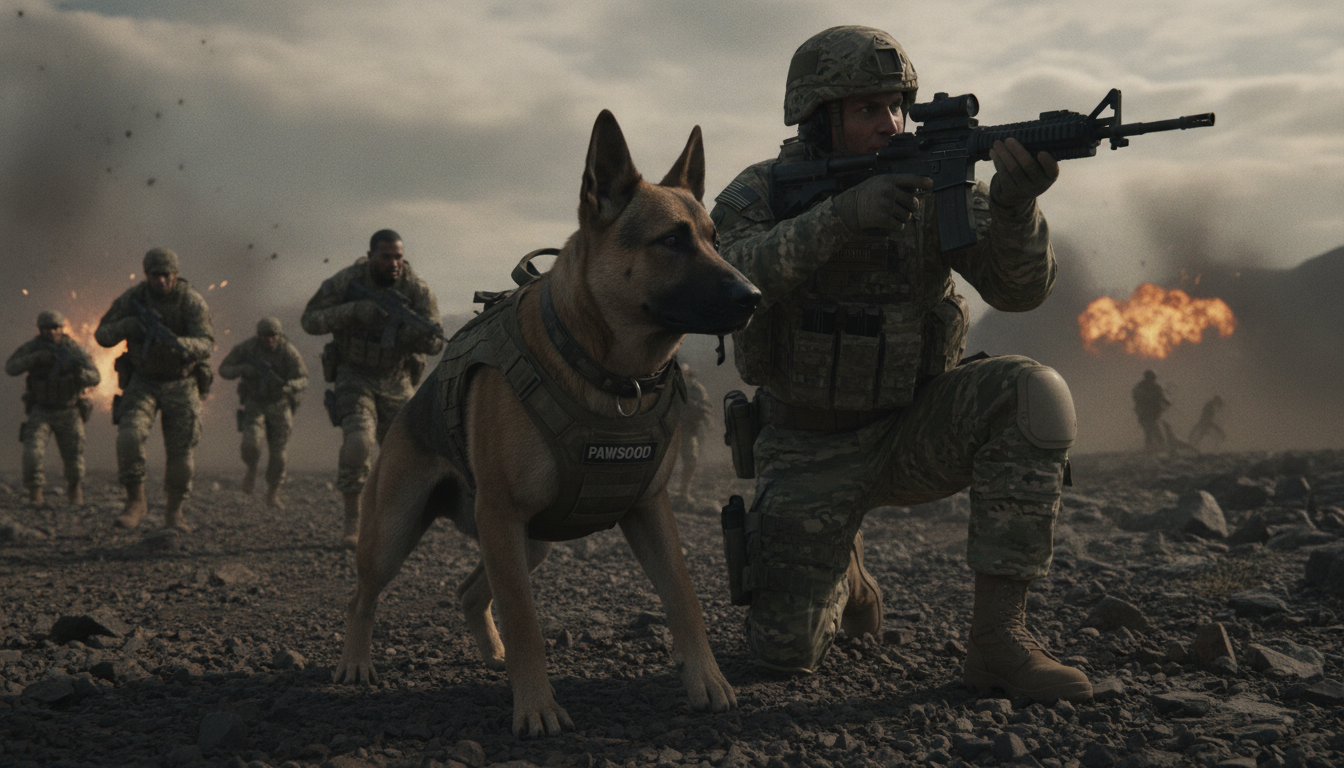
Picture yourself on a dusty road in Helmand Province. The sun is brutal. Your boots kick up powder with every step. Ten feet ahead, a Belgian Malinois moves along the shoulder, nose low, tail steady. She stops. She sits. Everyone behind her stops breathing for a second. That pause just saved a convoy.
This is the plain truth about military working dogs: they find what your eyes, your ears, and your gear simply cannot. A human nose carries around 5 million scent receptors. A dog’s nose carries about 220 million. That gap is the whole story.
The numbers back it up. Technology alone catches roughly 50% of buried explosives. Add a trained dog to the team and that rate climbs to about 80%. In controlled detection work, skilled dogs hit accuracy near 98%. No sensor on the market matches that for the price.
Look at the record across conflicts and the scale gets clearer. War dogs are credited with protecting more than 15,000 lives in World War II, over 10,000 in Vietnam, and another 15,000-plus across Iraq, Afghanistan, and modern operations. Military dogs save soldiers lives in ways that rarely make headlines.
You’re about to walk through how a combat K9 team actually works — the training, the search patterns, the alerts, and the real dogs behind the stats. If you love working dogs, resources like Pawsood dig deeper into what these animals do and how they live. This guide keeps things practical, not academic.
Key Takeaways
- Dogs have roughly 220 million scent receptors compared to about 5 million in humans, giving them detection power no machine can copy.
- Explosive detection rates jump from around 50% with equipment alone to about 80% when a trained dog joins the patrol.
- Well-trained detection dogs reach accuracy levels near 98% in identifying target odors.
- War dogs are credited with protecting more than 15,000 lives in WWII and over 10,000 in Vietnam.
- Modern operations in Iraq and Afghanistan added another 15,000-plus lives protected by canine teams.
- A combat K9 does more than sniff — it clears rooms, screens vehicles, disrupts ambushes, and lifts unit morale.
- The handler-dog bond is the real engine behind every successful find in the field.
Why Military Dogs Save Soldiers’ Lives Every Single Day
Ask any handler what keeps a patrol alive, and you’ll rarely hear about gear. You’ll hear about a dog. Military working dogs earn their keep in seconds — the short window between a scent hitting the nose and a squad stopping in its tracks.
The Partner Who Walks Point
“Walking point” means taking the lead position on patrol, the spot with the highest risk. On foot patrols, canine soldiers often work 25 to 50 yards ahead of the lead soldier, reading the ground and the wind long before human eyes catch anything unusual.
One handler put it plainly: “Our lives are in this dog’s hands.” That’s not a figure of speech. If the dog misses an odor, people get hurt. If the dog alerts, everyone freezes and lives.
The trust runs both directions. Dogs in k9 units eat with their handlers, sleep beside them, and ride in the same vehicle. They’re teammates with paws, not equipment in a crate.
What You’ll Learn in This Guide
Here’s what’s coming as you keep reading:
| Topic | What You’ll Take Away |
|---|---|
| Scent detection | Why a dog’s nose outperforms handheld detection gear |
| IED clearance | How detection rates climb when a dog leads the route sweep |
| Searches and patrols | Buildings, vehicles, tunnels, and ambush prevention |
| Training | How military dog teams build trust from puppy selection forward |
| Real cases | Named dogs whose alerts saved entire squads |
| Historical impact | Lives saved across WWII, Vietnam, Iraq, and Afghanistan |
How Military Working Dogs Detect Threats You Can’t See
Your eyes miss buried wires. Your ears miss a man breathing behind a mud wall. A dog’s nose catches both. That gap between human perception and canine biology is the reason military working dogs walk ahead of the formation instead of behind it.
Five Million vs. 220 Million Scent Receptors
You carry roughly 5 million olfactory receptors in your nose. A German Shepherd or Belgian Malinois carries around 220 million. The brain region that processes those signals is proportionally about 40 times larger in a dog than in you.
Anatomy stacks the deck further. Dogs breathe and sniff at the same time, so scent keeps flowing while they work. Their vomeronasal organ reads chemical traces your nose can’t register at all. Trained military canines pick up explosive vapor at a few parts per trillion, even when the device sits under packed dirt and gravel.
Why Detection Accuracy Reaches 98%
Certified IED detection dogs regularly test above 90% accuracy, with top teams clearing 98% under controlled conditions. Handheld metal detectors stall when a bomb uses plastic jugs and wooden pressure plates. A nose reads the chemistry, not the container.
| Capability | Human Soldier | Trained Detection Dog |
|---|---|---|
| Olfactory receptors | ~5 million | ~220 million |
| Scent-processing brain area | Baseline | ~40x larger proportionally |
| Lowest detectable concentration | Parts per thousand | Parts per trillion |
| Works through plastic and soil | Rarely | Consistently |
| Search speed, 100-meter road | 30-45 minutes | 8-12 minutes |
How to Read Your Dog’s Alert
- Change of behavior: tail stiffens, pace slows, head snaps back to a spot.
- Passive alert: the dog sits or lies down and stares at the source.
- Bracketing: tight circling as your combat K9 narrows the scent cone.
- Refusal: the dog stops and won’t advance. Stop with him.
How IED Detection Dogs Clear Roads Before Your Convoy Rolls
Roadside bombs were the number one killer of coalition troops in Iraq and Afghanistan. Metal detectors, robots, and jammers helped, yet buried explosives packed in plastic jugs or wooden boxes slipped past them again and again. That gap is where four legs and a wet nose changed everything.
From 50% to 80% Detection Rates
Working alone, detection equipment locates roughly half of hidden IEDs. Add a trained dog to the sweep and that number climbs to about 80%. Those extra 30 points are lives, not statistics.
| Method Used | Approximate Detection Rate | What It Means on a Route |
|---|---|---|
| Technology and equipment only | 50% | Half of all buried devices stay live under your tires |
| Equipment paired with IED detection dogs | 80% | Most devices found before the lead vehicle reaches them |
The Pentagon saw those results and expanded tactical dog units fast, fielding hundreds of specialized teams across both theaters.
Working the Search Pattern
Route clearance follows a rhythm you can count on:
- The handler releases the dog 50 to 100 yards ahead of the convoy.
- The dog sweeps in a zigzag across the road, shoulders, and culverts.
- A passive sit or freeze marks the odor source.
- EOD moves in while military dog teams pull back to a safe distance.
Why Handlers Trust the Nose Over the Machine
Batteries die and sensors misread wet soil. Military working dogs read scent drifting from a buried charge no matter what container hides it. Ask any handler which tool they want walking point, and the answer comes back with a tail wag.
How Combat K9 Teams Search Buildings, Vehicles, and Tunnels
Open roads are one problem. Enclosed spaces are another entirely. Walls block sightlines, corners hide people, and a metal detector can’t tell you what’s behind a false panel. That’s where a trained nose earns its keep.
Room Clearing and Compound Sweeps
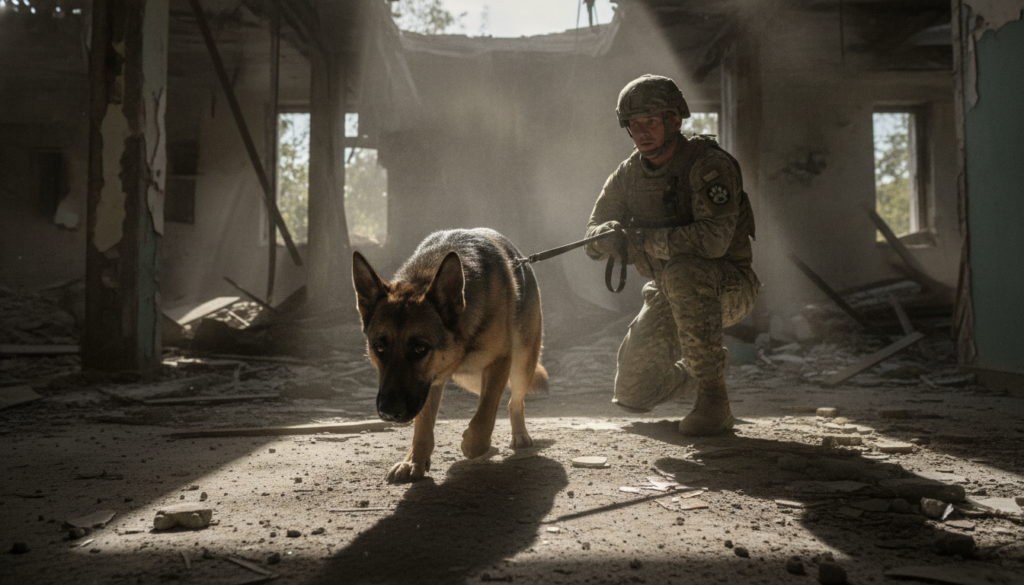
Your dog goes through the doorway first. Stairwells, courtyards, storage rooms, and suspicious walls all get checked before anyone stacks up and commits to the entry. Patrol-trained military working dogs locate hidden personnel by scent, while detection training flags weapons caches, ammunition, and homemade explosive precursors buried under floors or sealed inside masonry.
Special operations teams often field Multi-Purpose Canines that handle both jobs. Some wear harness-mounted cameras with two-way audio, letting a handler watch the feed and send commands from cover.
Vehicle and Checkpoint Screening
At checkpoints, k9 units work a fixed circuit around each vehicle: wheel wells, bumpers, seams, undercarriage, cargo bed. A sweep takes a couple of minutes and doesn’t require unloading the truck.
Tunnels, Caves, and Confined Spaces
Underground work is where tactical dog units shine and where risk climbs fast. Air pockets trap scent, so a combat K9 can pick up explosive odor or human presence deep inside a passage.
| Search Environment | Primary Threat | Typical K9 Advantage |
|---|---|---|
| Compound rooms | Hidden fighters, caches | Dog enters ahead of the stack |
| Vehicle checkpoint | VBIEDs, smuggled arms | Fast sweep, no unloading |
| Tunnels and caves | Ambush, stored munitions | Scent pools in still air |
How K9 Units Stop Ambushes Before They Start
Searching a building is one job. Walking a trail where someone is waiting for you is another. Scout and sentry dogs handle that second job, and they do it with senses your patrol simply doesn’t have.
A trained scout dog picks up human scent carried on the wind, hears movement behind vegetation, and notices ground that’s been dug up or covered. That warning often comes 100 to 300 yards before your point man would see anything at all. K9 units use this early notice to stop, take cover, or maneuver around the kill zone instead of walking into it.
The alert is silent by design. No barking. The dog freezes, lifts its head, swings its ears toward the threat, and raises its hackles. Handlers in military dog teams read that body language in seconds and pass the signal down the line without a word.
Marine scout dogs proved this in the Pacific. Kurt, a Doberman, alerted on hidden Japanese positions on Guam in 1944 and is credited with saving the platoon behind him. He’s buried at the War Dog Cemetery on Guam. Skipper and Otto gave similar warnings on Guam and Bougainville, halting units short of prepared ambush lines.
| Scout Dog | Campaign | Outcome of the Alert |
|---|---|---|
| Kurt | Guam, 1944 | Warned the lead Marine patrol; platoon behind him avoided contact |
| Skipper | Guam, 1944 | Signaled concealed enemy positions ahead of an advancing squad |
| Otto | Bougainville, 1944 | Stopped a patrol short of a waiting enemy line |
Here’s the part worth remembering: an ambush that never happens makes no headlines. That’s exactly why the lifesaving record of war dogs and canine soldiers stays badly undercounted.
How Canine Soldiers Find the Wounded and Carry Messages
Detection work gets most of the headlines, but war dogs have saved just as many lives by finding injured troops and moving critical messages across contested ground. Long before radios were reliable, a dog sprinting through shellfire was the fastest way to get word from the front line to headquarters.
Sgt. Stubby: Locating the Wounded in WWI
Stubby was a stray Boston Terrier mix who smuggled his way to France with the 102nd Infantry Regiment, 26th “Yankee” Division. He served in 17 battles.
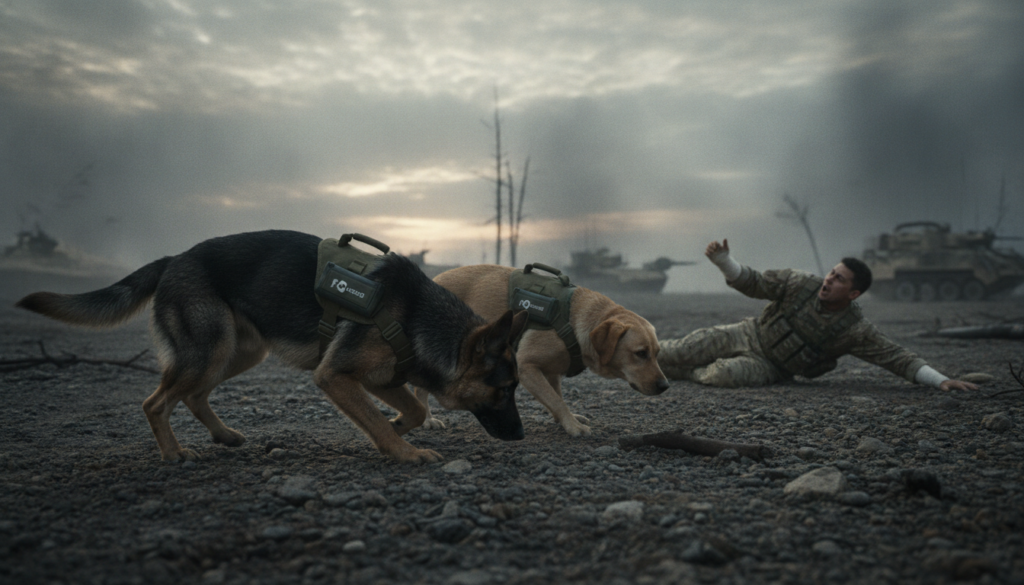
Out in No Man’s Land, Stubby searched for wounded men who couldn’t call out. When he found someone, he stayed put or barked until stretcher bearers reached the spot. He warned troops of incoming gas hours before they smelled it, alerted them to artillery, and once grabbed a German infiltrator by the trousers and held on until soldiers arrived. He remains the most decorated of all WWI military working dogs.
Caesar: Nine Missions Under Fire
Caesar, a German Shepherd messenger dog with the U.S. Marines on Bougainville in 1943, ran nine missions between his handler’s forward position and the command post. He carried orders, maps, and reports through jungle that radio signals couldn’t penetrate. He was shot during one run and still completed his work.
| Dog | Conflict | Primary Role | Documented Impact |
|---|---|---|---|
| Sgt. Stubby | World War I | Casualty location, gas alert | 17 battles; most decorated dog of the war |
| Caesar | World War II | Messenger and sentry | 9 missions delivered under enemy fire |
These roles echo today in service dogs in the military that guide medics and steady wounded troops during evacuation.
Inside Military Working Dog Training: How Trust Is Built
Those battlefield saves don’t happen by accident. Behind every alert is months of patient, repetitive work that turns a high-drive puppy into a reliable partner. Military working dog training builds skill first, then trust — and the trust is what keeps both ends of the leash alive.
Selecting the Right Dog
The Department of Defense Military Working Dog Program at Joint Base San Antonio–Lackland screens candidates hard, and only a minority finish the pipeline. Evaluators look for extreme hunt and prey drive, calm nerves in strange places, tolerance for loud noise, and an almost obsessive love of a rubber toy.
| Breed | Common Role | Standout Trait |
|---|---|---|
| Belgian Malinois | Patrol and explosives detection | Speed and relentless drive |
| German Shepherd | Dual-purpose patrol work | Versatility and presence |
| Dutch Shepherd | Patrol and apprehension | Grip strength and focus |
| Labrador Retriever | Detection-only, off-leash search | Friendly temperament, steady nose |
Scent Imprinting and Odor Recognition
Trainers pair target explosive odors with the dog’s favorite toy until the scent itself means playtime. Trained military canines learn to sit or freeze at the source, never digging or pawing. Repetition across hundreds of blind setups locks in accuracy.
Gunfire, Helicopters, and Stress Inoculation
Confidence gets tested on purpose. Dogs work through blank fire, rotor wash, smoke, slick floors, and helicopter rides so nothing on deployment feels new. Military working dogs that stay focused under this pressure earn a spot downrange.
Building the Handler Bond
You feed, groom, exercise, and train your dog daily. That constant contact is why military dog teams read each other’s smallest signals — a shifted ear, a tightened leash, a change in breathing.
Real Stories of Military Dog Teams That Saved Lives
Training statistics are one thing. Names and faces are another. These four dogs show you exactly how military dogs save soldiers lives when seconds matter and instinct beats instrumentation.
Azza in Afghanistan
On a dusty patrol route, Azza planted her paws and refused to move. Her handler stopped mid-step. Buried inches ahead sat a pressure-plate IED, later confirmed and neutralized by an EOD team. One alert from one combat K9 kept an entire patrol upright and walking home.
Sansón in Colombia
Sansón worked jungle trails where guerrilla groups seeded landmines along footpaths. His nose located caches of explosives and hidden devices that no metal detector picked up, protecting troops and rural villagers who shared the same roads.
Tyson in India
Tyson served with Indian Army military dog teams in counterinsurgency country, sniffing out weapons dumps and explosive material during cordon-and-search operations. His finds pulled ammunition off the battlefield before anyone could use it.
Kent in India
Kent, a Belgian Malinois assault dog, pushed into a building ahead of soldiers during a 2023 anti-terror operation in Jammu and Kashmir. He was fatally wounded taking fire meant for his team. The Army honored him for the lives he shielded.
| Dog | Theater | Specialty | Outcome |
|---|---|---|---|
| Azza | Afghanistan | IED detection | Buried device found in handler’s path |
| Sansón | Colombia | Mine and explosive search | Trails cleared for troops and civilians |
| Tyson | India | Weapons and ammo detection | Hidden caches recovered |
| Kent | India | Assault and entry | Absorbed fire, saved his team |
War dogs like these turn quiet moments into survivable ones.
How War Dogs Changed Survival Odds in Every Conflict
Individual stories hit hard, but numbers tell you something bigger. Across three major eras of American warfare, war dogs have pushed casualty rates down and brought thousands of troops home. Here’s how those totals stack up.
World War II: 15,000+ Lives Saved
The Dogs for Defense program asked American families to loan their pets to the Army. Roughly 10,000 dogs made it through the War Dog Program and shipped out as scouts, sentries, messengers, and mine detectors across the Pacific and Europe.
Marine war dog platoons on Bougainville and Guam produced one of the most quoted stats in military history: no patrol led by a dog was ever ambushed. Credit for lives saved tops 15,000.
Vietnam: 10,000+ Lives Saved
About 4,000 military working dogs served in Vietnam alongside 10,000 handlers. Scout dogs walked point through elephant grass and tunnel complexes, spotting trip wires and punji pits. Veterans groups credit these teams with saving more than 10,000 American lives.
Iraq, Afghanistan, and Modern Operations: 15,000+ Lives Saved
IED detection became the defining mission. K9 units cleared routes, screened vehicles, and swept compounds. Estimates place lives saved above 15,000 in these campaigns.
| Conflict | Dogs Deployed | Primary Roles | Estimated Lives Saved |
|---|---|---|---|
| World War II | ~10,000 trained | Scout, sentry, messenger, mine detection | 15,000+ |
| Vietnam War | ~4,000 deployed | Scout, tracker, tunnel, sentry | 10,000+ |
| Iraq & Afghanistan | ~2,500 active annually | IED detection, patrol, special operations | 15,000+ |
What the Numbers Tell You About Today’s Battlefield
Threats keep changing, and dogs keep adapting. That flexibility sits at the heart of the benefits of using military dogs, and it explains why no machine has replaced them yet.
Benefits of Using Military Dogs Beyond Threat Detection
Sniffing out bombs is only part of the job. The wider benefits of using military dogs show up in quiet moments: a tense checkpoint that stays calm, a soldier who sleeps better, a budget that stretches further.
Presence That Ends Fights Before They Start
A patrol dog changes behavior just by standing there. Crowds back up. Perimeter probing stops. Handlers call it the presence effect, and it resolves plenty of situations without a single shot.
K9 units give commanders a non-lethal option in three common spots:
- Base perimeters — visible patrols discourage fence testing at night
- Entry control points — drivers cooperate faster when a dog works the line
- Detainee escort — controlled tension keeps hands where you can see them
Morale and Mental Health on Deployment
Troops talk to the dog when they won’t talk to anyone else. Service dogs in the military lower stress, ease homesickness, and give a unit something to care for. Veterans paired with trained companions report fewer PTSD symptoms and better sleep.
Cost and Speed Against Machines
| Factor | Tactical Dog Units | Robotic Detection Systems |
|---|---|---|
| Search speed | Covers open terrain quickly on foot | Slower, grid-bound sweeps |
| Weather tolerance | Works in mud, heat, and rain | Sensitive to dust and moisture |
| Homemade explosives | Detects low-metal devices by odor | Often misses non-metallic builds |
| Extra roles | Patrol, deterrence, morale support | Detection only |
Ways You Can Help
- Donate to the United States War Dogs Association for care packages and vet bills
- Support Mission K9 Rescue, which reunites retired dogs with their handlers
- Adopt a retired working dog through Lackland Air Force Base
- Back legislation funding lifetime medical care for retired K9s
Conclusion
The numbers tell a clear story. Your nose carries about 5 million scent receptors. A working dog’s nose carries 220 million. That gap turns into 98% detection accuracy in the field, and it pushes IED detection rates from roughly 50% to 80% the moment a dog joins the patrol. Across World War II, Vietnam, and modern operations, more than 40,000 troops came home because of military working dogs.
Behind every statistic stands a real dog. Azza froze mid-step in Afghanistan and stopped a patrol from walking into a buried charge. Sansón shielded 36 soldiers in Colombia at once. Tyson kept pushing forward in India on a wounded leg. Kent took the bullets meant for his team. These canine soldiers didn’t calculate risk. They trusted their handler and did the job.
One handler summed it up better than any report could: “Our lives are in this dog’s hands.” That’s the honest weight of a combat K9 partnership. The dog reads the wind, the ground, and the silence. The team walks forward because the dog says it’s safe.
You’ve seen how military dogs save soldiers’ lives, how they’re selected, trained, and bonded to the people beside them. Keep learning about these animals, and give something back to the ones stepping into retirement. Pawsood is a great place to start following their stories and finding ways to help.